
Revolutionary Reading
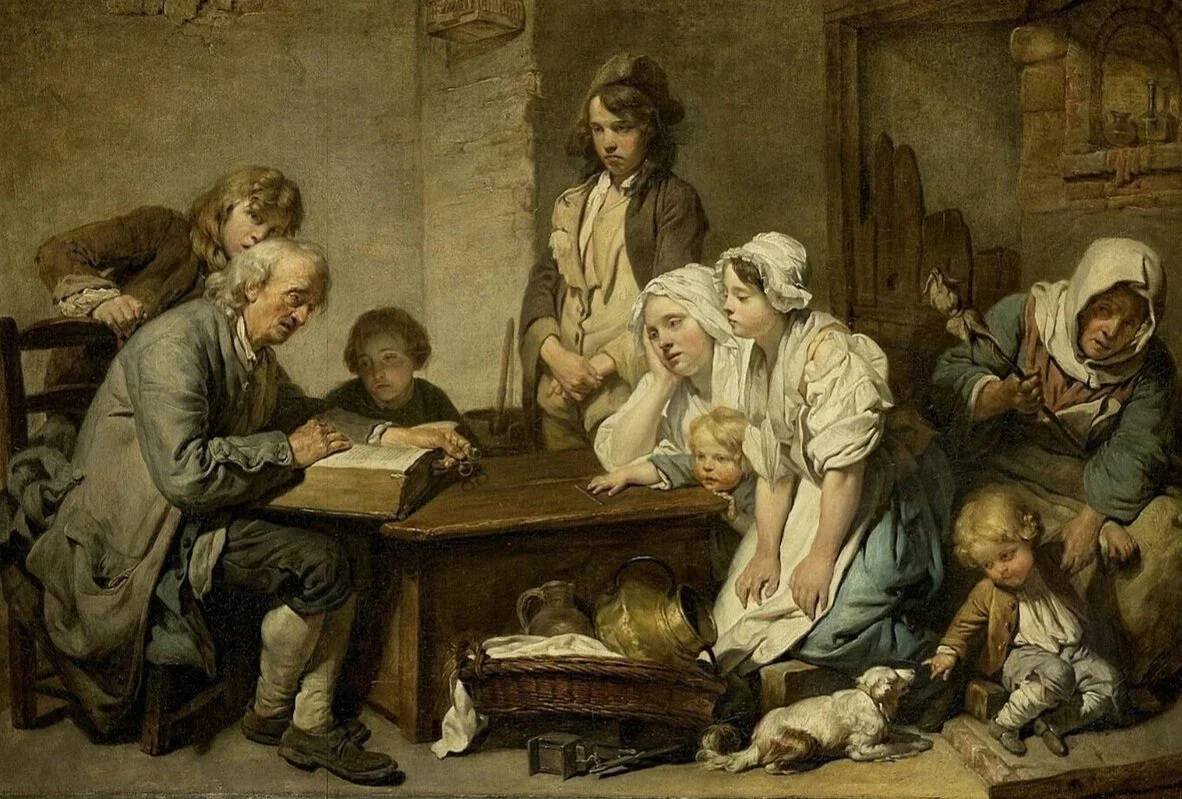
“The Bible Reading”
- Jean-Baptiste Greuze - 1755
Admittedly, I am not the best reader, nor do I read novels as frequently as I would like. I am a lot like most parents today. Once the kids are in bed for the night, I help clean up the house, fold laundry, turn on the TV, or sit on my phone reading articles on ESPN. But when I have been reading a good book (or even watching my wife read a good book), there is a different kind of pull, the desire to finish my responsibilities so I can return to it. That kind of enjoyment is rare and refreshing.
There is something deeply satisfying about entering into a story. The wonder and imagination that accompany reading allow our minds to engage in a unique way. We form images of characters and settings that may look entirely different from how someone else envisions them while reading the same book. Reading is a fantastic way for adults to be able to “wonder”.
I normally read a handful of books each year, but this year I am aiming to read at least a few purely for pleasure, in addition to the books I enjoy reading with our kids. I want reading not simply to be informational, but enjoyable. According to a study conducted by the National Institutes of Health, the trend over the past 20 years shows a steady decline in reading for pleasure within the general U.S. population. With the explosion of the tech industry and the rise of smartphones during this same period, it is not surprising that reading for pleasure has decreased.
As adults, we carry many roles, responsibilities, and relationships that compete for our time. Nearly every adult also carries a smartphone that quietly competes for our attention during whatever free moments remain. It is easy to say, “I simply don’t have time to read.” And in some seasons of life, that may feel true. But not in all seasons. And perhaps not as permanently as we assume.
I raise this for three main reasons.
First, reading as an adult can be, and truly is, a joy. It is a good gift from God to delight in stories, ideas, and language. There are even well-documented health benefits to reading, but beyond those, there is simple enjoyment. It nourishes the mind and body in a way that scrolling does not.
Second, our enjoyment of reading will shape our children more than we realize. Children often catch more from what we do than from what we say. If we tell our children that reading is important, but they never see us open a book for pleasure, our words will ring hollow. When they see Mom or Dad reading, not out of obligation, but out of delight, they begin to understand that books are not burdens but gifts.
Lastly, we want our children to love and enjoy good books for their own growth and development. Research consistently shows that reading and child development go hand in hand. Reading strengthens comprehension, builds vocabulary, expands imagination, and develops critical thinking. It forms habits of attention that serve children for a lifetime.
As Christian parents, our desires go even deeper. We do not simply want our children to become skilled readers for the sake of academic or professional success. The primary way we come to know our God and Father is through His written Word. While true understanding of Scripture ultimately depends upon the work of the Spirit (1 Corinthians 2:6–13), literacy is a gift that places our children in a position to encounter the truth of God’s revelation. We pray that as they learn to read well, they would one day read His Word with understanding and wisdom from above.
One practical way we can begin shaping this love is by helping our children develop a taste for good books now. Families, churches, and schools share in this responsibility. We can provide rich literature, read together regularly, and talk about what we are reading. Even as children grow older, shared stories create shared memories. There are few sweeter bonds than those formed over books read aloud on the couch or discussed around the dinner table.
Earlier this year, The Guardian highlighted a survey brought to light by a New York Times article titled, “Kids Rarely Read Whole Books Anymore. Even in English Class.” In many schools, students are no longer required to read entire books but instead are assigned excerpts. These trends, particularly within the government school sector, are sad. Something is lost when children are not invited to persevere through a full story. How will children experience the satisfaction of finishing a great book if they are never asked to do it? Can an excerpt on a laptop replace immersion in physical book from start to finish? In the article, the teachers who still require full novels are described as “revolutionaries.” Is it really revolutionary to require children to read full books?
Children are far more capable than we often give them credit for. We at White Horse Academy readily acknowledge that we are not masters of education and that we still have a lot to learn. However, we are confident in a few truths:
Reading is vital to the education of our children.
Reading is a joy, and we want our students to experience that joy.
Reading helps us know God and understand the world He has made.
Reading forms habits of attention and reflection that shape lifelong learners.
Let us not surrender this ground lightly. Let us model what we hope to cultivate. Let us remind our children, by word and example, that reading is not merely an academic exercise, but a doorway to wisdom, wonder, and ultimately to the knowledge of God Himself.
If you long for your child to engage in the “revolutionary” act of reading, eagerly devouring complete, physical books from cover to cover, then schedule a tour of White Horse Academy today.